
- In Stock | Ships in 1-3 days
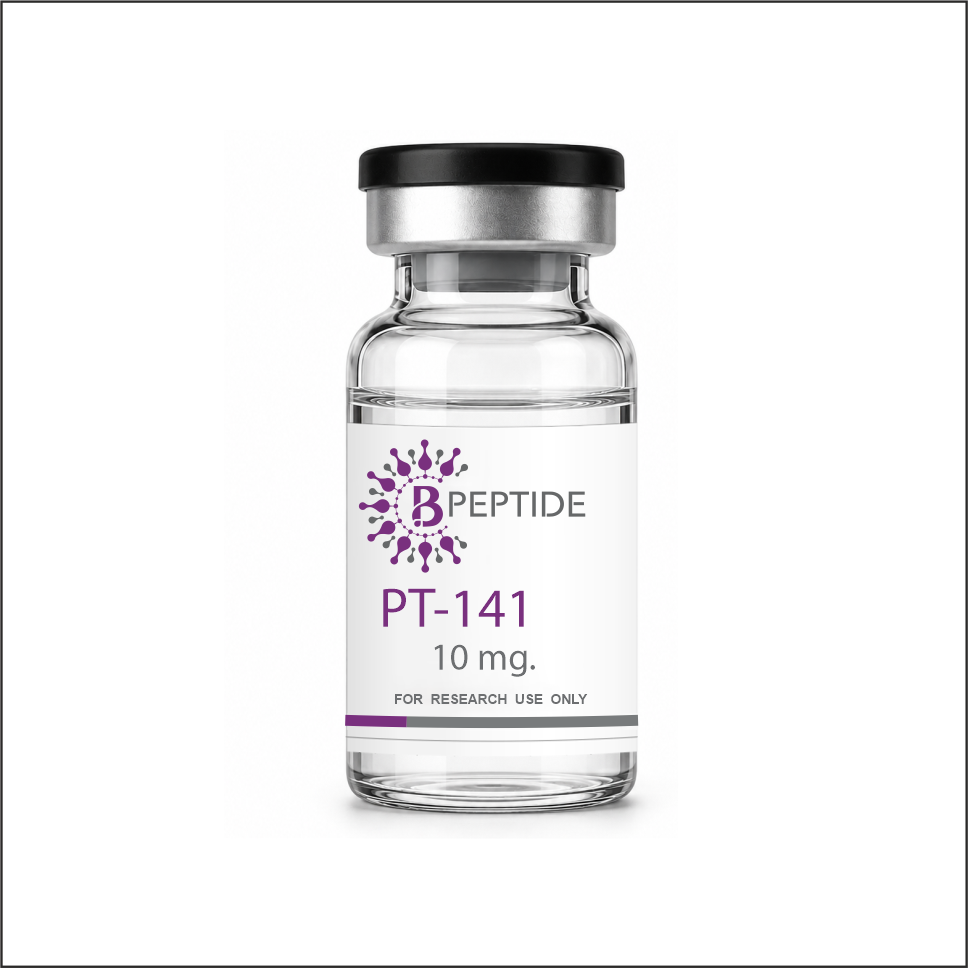
PT-141 10mg | Mitochondrial Health & Cellular Repair Research Peptide
Bremelanotide (PT-141) is lyophilized cyclic heptapeptide used as a melanocortin receptor tool compound, studied here for downstream cellular repair and mitochondrial health tracking.
$120.00 Original price was: $120.00.$100.00Current price is: $100.00.
- Free Shipping
Suggested protocol
- Timing: Morning
- Cycle: 4-8 weeks ON / 4 week OFF
- Goal: Mitochondrial health, cellular repair

High
Purity

CoA
Available

Cold-Chain
Shipping

Secure
Ordering
PT-141 (Bremelanotide) is a synthetic cyclic heptapeptide derived from alpha melanocyte stimulating hormone (alpha MSH). It is widely used as a non selective melanocortin receptor tool compound, with documented binding activity across the MC1R, MC3R, MC4R and MC5R subtypes. This listing is used in laboratory investigations into mitochondrial health and cellular repair, with research focus on melanocortin receptor activation and its secondary, downstream impacts on systemic tissue recovery markers. BPeptide’s PT-141 10mg is supplied as a lyophilized powder and is verified for identity and purity by independent third party analysis.
Cellular Repair Tracking
Studied for downstream signaling effects relevant to tissue recovery and cellular repair markers following melanocortin receptor activation.
Mitochondrial Health Research
Used in protocols tracking mitochondrial efficiency and tissue integrity markers across extended observation cycles.
Melanocortin Receptor Activation
Non selective agonist activity across MC1R, MC3R, MC4R and MC5R, well characterized in published receptor pharmacology literature.
Stable Cyclic Structure
The cyclic lactam architecture improves resistance to enzymatic degradation, supporting reproducible in vitro assay conditions.
Standard Reconstitution Protocol
- Allow the vial to reach room temperature before opening.
- Wipe the rubber stopper with 70% isopropyl alcohol.
- Using a sterile syringe, add 1.0-2.0ml of bacteriostatic or sterile water slowly down the inner wall of the vial so do not inject directly onto the powder.
- Gently swirl until fully dissolved. Do not shake or vortex because this can denature the molecule.
- Label the vial with date of reconstitution.
- Store refrigerated, protected from light and avoid repeated freeze thaw cycles.
| Reconstitution solvent | Bacteriostatic water (preferred) or sterile water |
| Recommended volume | 1.0-2.0ml per 10mg vial |
| Storage after reconstitution | 2-8°C, in dark, upright |
| Freeze thaw cycles | Avoid; do not freeze reconstituted solution |
| Suggested cycle | 4-8 weeks ON, 4 week OFF |
| Maintenance cycle | Repeat periodically for longitudinal tracking |
What is PT-141 used for in research?
How do you reconstitute PT-141 10mg powder?
What is the purity of this PT-141 peptide?
How should PT-141 powder be stored?
What is the suggested research protocol timing?
Do you ship internationally?
What is PT-141 and How Does It Relate to Cellular Repair Research?
PT-141 (Bremelanotide) is a synthetic cyclic heptapeptide structurally derived from alpha melanocyte stimulating hormone (alpha MSH), built around a lactam-bridged ring that gives it improved resistance to enzymatic degradation compared with linear peptide analogs. Its sequence, Ac-Nle-cyclo[Asp-His-D-Phe-Arg-Trp-Lys]-OH, is well characterized in the published pharmacology literature, where it is best known as a non selective agonist across the melanocortin receptor family (MC1R, MC3R, MC4R and MC5R).
The melanocortin system is most extensively studied for its role in central nervous system pathways, including its established research history around MC3R and MC4R signaling. Within that broader research landscape, this listing focuses on a narrower, less conventional application: examining how downstream signaling following melanocortin receptor activation may relate to cellular repair processes and mitochondrial efficiency. Researchers exploring this angle typically track tissue integrity markers across defined administration cycles, looking for secondary or indirect effects rather than a primary, well established mitochondrial mechanism.
Because PT-141’s receptor pharmacology is thoroughly documented elsewhere, it serves as a structurally stable, reproducible tool compound for laboratories designing exploratory studies into these secondary research questions. As with any tool compound applied outside its most established research context, results should be interpreted alongside the wider melanocortin receptor literature.
Related products
-
Recovery & Gut Health
Ipamorelin 10mg | Sleep & Cellular Renewal Research Peptide
$120.00Original price was: $120.00.$100.00Current price is: $100.00. Add to cart -
Recovery & Gut Health
Thymosin Alpha-1 10mg | Gut Health & Inflammation Research Peptide
$120.00Original price was: $120.00.$100.00Current price is: $100.00. Add to cart -
Recovery & Gut Health
CJC-1295 10mg | Tissue Structural Repair Research Peptide
$120.00Original price was: $120.00.$100.00Current price is: $100.00. Add to cart
Reviews
There are no reviews yet.